Segmentation of lung CT scans to identify COVID-19 infection using U-Net CNN architecture
Mackenzie Looney
mackenzie.looney@duke.edu
| Paper PDF |
|
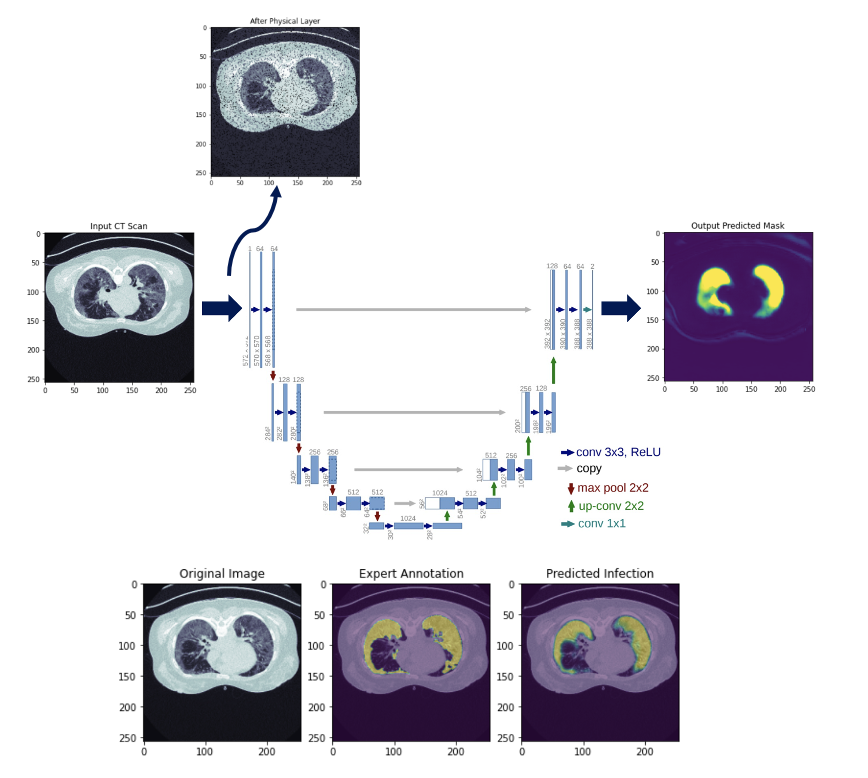
The rapid spread of COVID-19 has led to a variety of tools being developed and utilized for detection, prognosis and management of the disease. One such tool is the use of lung CT scans to identify infection. This may be most beneficial for early detection and disease management. This paper focuses on the design of a convolutional neural network model to predict the location of COVID-19 infection on lung CT scans. The model is developed with and without a physical layer, and both versions of the model are evaluated with an intersection over mean metric. A goal of the project is to allow for reduced radiation exposure by creating a model that could accurately predict the location of COVID-19 infection on images with simulated noise artifacts. Twenty CT scans of COVID-19 patients were used to develop and evaluate the model. The results of this project show that a physical layer consisting of the weighted sum of various levels of noise consistently led to better segmentation results.
|
|
|
| Paper: |
Code and Data:
|